
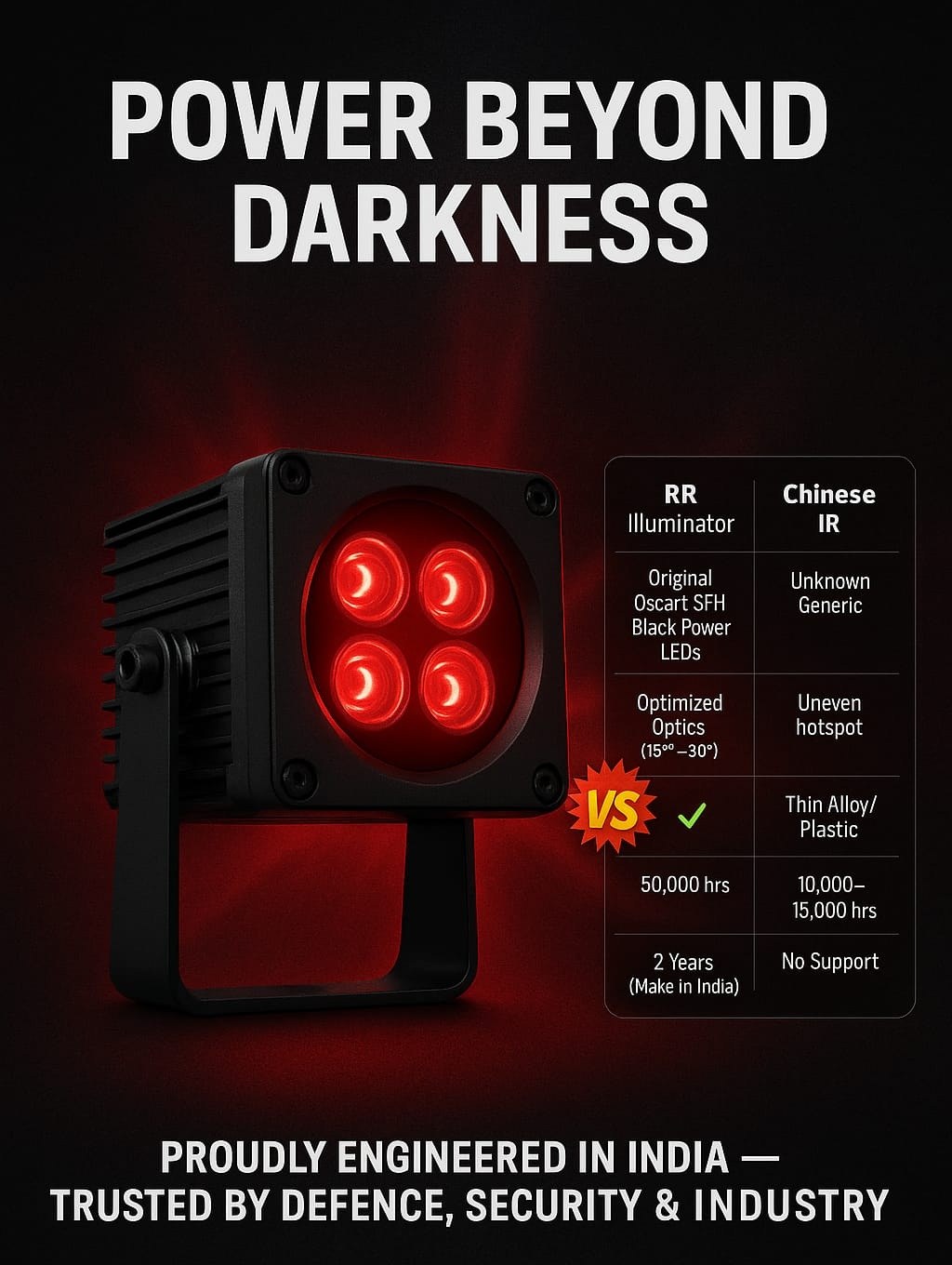
Conceptual educational illustration; not a product photograph or laboratory benchmark.
A common mistake in infrared surveillance purchasing is to count LEDs and treat the result as a performance rating. A 48-LED unit can consume less electrical power than a 6-LED unit. That does not automatically make either one better. To evaluate performance, buyers need to distinguish LED count, electrical power, optical radiant output and beam distribution.
LED count is a component count, not a wattage rating
Different LED packages operate at different currents and voltages. Two units with the same number of LEDs can have different power consumption because of drive current, series/parallel arrangements, control electronics and efficiency. A photograph cannot reveal these details.
Illustrative example
| Example | LED packages | Measured electrical input |
|---|---|---|
| Unit A | 48 | 15 W |
| Unit B | 6 | 24 W |
Hypothetical values for education only. Not measured results from RST or a competitor.
Unit B draws more electrical power in this example, but higher input power alone cannot prove greater useful illumination. Efficiency, wavelength, optics, heat, beam alignment and camera sensitivity also affect the outcome.
Electrical watts are not optical watts
Electrical input power is the power drawn from the supply. For a DC input, an approximate calculation is P = V × I. For AC mains, real power requires appropriate wattmeter measurement; multiplying RMS voltage by RMS current alone yields apparent power, not necessarily real watts.
Radiant flux is optical infrared power emitted, usually expressed in optical watts or milliwatts. Radiant intensity describes radiation per unit solid angle, commonly in mW/sr. LED and driver losses convert some electrical input into heat, so these measurements are not interchangeable.
Why lens and beam angle matter
A narrow beam concentrates available radiation into a smaller scene; a wide beam spreads it across a larger field. Neither is universally better. A zoomed PTZ camera may benefit from a tighter beam, while a wide fixed camera needs broad and reasonably uniform coverage. Misalignment can leave part of the image dark even with a powerful illuminator.
Wavelength: 850 nm vs 940 nm
850 nm illuminators are often selected for their compatibility with many surveillance sensors, although the emitter may show a faint red glow. 940 nm can reduce visible glow but may require more optical power or camera gain for comparable imaging because camera sensitivity often differs. Always check the specific camera's spectral response and test conditions.
Heat management and constant-current drive
High-power IR LEDs need a correctly designed driver and thermal pathway. Excess temperature can reduce optical performance and accelerate degradation. A constant-current driver helps regulate LED current despite supply or temperature changes. Product specifications should state allowable input supply and operating environment.
A practical measurement checklist
- Record real input power at the specified supply voltage.
- Confirm the LED make, part number and peak wavelength.
- Request optical output or radiant intensity data if available.
- Check beam angle and intensity distribution at the camera's actual zoom.
- Compare footage at the same distance, exposure, gain and shutter settings.
- Inspect thermal stability after sustained operation, not just at switch-on.
- Confirm ingress protection and written warranty.
RST's performance-first philosophy
RST Ecoenergy positions its IR illuminators around declared electrical wattage, specified OSRAM OSLON Black emitters, selected optics and aluminium die-cast construction, rather than treating LED quantity as a substitute for technical data. Exact electrical and optical specifications depend on the chosen product variant and should be supplied with the product documentation.
Frequently asked questions
Is a 30 W IR illuminator always better than a 15 W unit?
No. Input wattage is only one factor; useful optical output and beam distribution matter.
Does adding more LEDs increase range?
Not necessarily. Range depends on usable radiant intensity, target reflectivity, camera sensitivity, lens, exposure and environmental conditions.
How can I verify advertised wattage?
Measure input power with suitable calibrated equipment under the rated operating conditions, and distinguish electrical input from LED-only or optical output figures.
Request an application-matched IR illuminator
Send your camera model, target distance, preferred input voltage and operating environment for a technical discussion.