

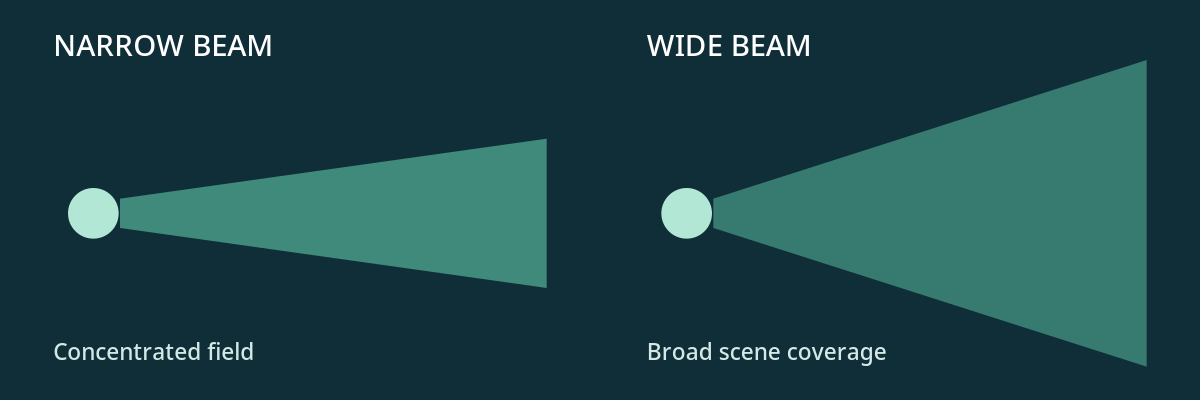
Conceptual educational illustration; not a product photograph or laboratory benchmark.
An infrared illuminator should be selected for the camera, target, mounting position and environment—not from an LED count or a maximum-distance claim alone. A correctly matched system can improve usable night images while avoiding bright hotspots, dark corners and unnecessary power consumption.
Step 1: Start with the camera
Identify the camera model, sensor, lens and night-mode capability. Confirm whether the camera can detect 850 nm or 940 nm infrared light. Some cameras with IR-cut filters will not see external IR in daytime mode. For PTZ cameras, note the zoom positions at which night surveillance is actually required.
Step 2: Define the real operating distance
Distinguish detection, recognition and identification requirements. Seeing that an object exists is different from reading a marking or recognising a face. Useful range depends on camera pixels on target, scene contrast, target reflectance, atmosphere, exposure and optical intensity. Ask vendors what their range claim actually means.
Step 3: Match beam angle to camera field of view
For a fixed camera, choose optics that cover the intended horizontal and vertical field with some alignment margin. For a PTZ camera, a fixed wide illuminator can waste light at telephoto zoom; a narrow illuminator can create dark edges when zoomed out. A lens selected according to FOV is more useful than simply adding LEDs.
Step 4: Select wavelength intelligently
850 nm is widely used for CCTV applications and is compatible with many IR-sensitive cameras. 940 nm is useful where reduced visible emitter glow matters, but the actual camera response may be lower. Compare results using the same camera before committing to a wavelength.
Step 5: Verify electrical power and supply architecture
Ask for rated input voltage, tolerance, real input wattage, surge/inrush behaviour and wiring protection. RST describes configurable 12 V DC, 24 V DC and 220–230 V AC options subject to the product model. An integrated AC-input model still needs correctly engineered internal conversion and appropriate safety design. An external adapter is not inherently inferior if correctly specified and certified.
Step 6: Review enclosure, cooling and mounting
For outdoor, industrial and perimeter deployments, check the stated IP rating, gasket and cable-gland design, corrosion resistance, operating temperature, vibration and mounting adjustment. Aluminium die casting can provide a useful thermal path, but actual thermal performance must be verified. Avoid inferring an IP rating from appearance alone.
Step 7: Check serviceability, documentation and warranty
Request the LED part number, beam chart, wiring instructions, environmental specifications, test evidence, and written warranty exclusions. RST states manufacturing warranty options of one to two years depending on configuration; obtain the final term in writing for the ordered model.
Procurement checklist
| Requirement | What to record |
|---|---|
| Camera | Make/model, IR mode, lens and zoom range |
| Scene | Target type, distance, width and reflectivity |
| Illumination | 850/940 nm, beam angle, measured input and optical data |
| Power | 12/24 V DC or AC configuration, protections |
| Environment | IP rating, temperature, mounting, corrosion |
| Support | Warranty, test report, installation documentation |
Example: choosing for a zoom CCTV camera
Suppose a camera monitors a broad gate at low zoom but checks a distant object at high zoom. A single narrow IR beam may help at telephoto settings but leave the gate edges dark at low zoom. A broad beam covers the gate yet may not deliver sufficient intensity at distance. The appropriate solution requires matching illumination geometry to the required zoom positions, potentially using separate illuminators or controlled optics.
Why consider an application-matched RST configuration?
RST Ecoenergy offers an engineering-led approach using specified OSRAM OSLON Black emitters, aluminium die-cast housing and application-selected optics. The most effective next step is to provide the camera model, required distance, target size, supply and installation environment so the appropriate variant can be quoted with confirmed specifications.
Frequently asked questions
Which IR wavelength is best for CCTV?
It depends on camera sensitivity and whether a faint red emitter glow is acceptable. Test the intended camera at the required range.
Can a PTZ camera use a fixed IR illuminator?
Yes, but coverage changes relative to the camera's field of view as zoom changes. Plan for the actual operating positions.
Does the highest advertised range guarantee better images?
No. Range figures are not comparable without a common test method and image-quality target.
Request an application-matched IR illuminator
Send your camera model, target distance, preferred input voltage and operating environment for a technical discussion.